

Meadowsweet: Let It Seep

Originally published in 2022. Updated for Storybound Press.
“...for the smell thereof makes the heart merrie and joyful and delighteth the senses.”
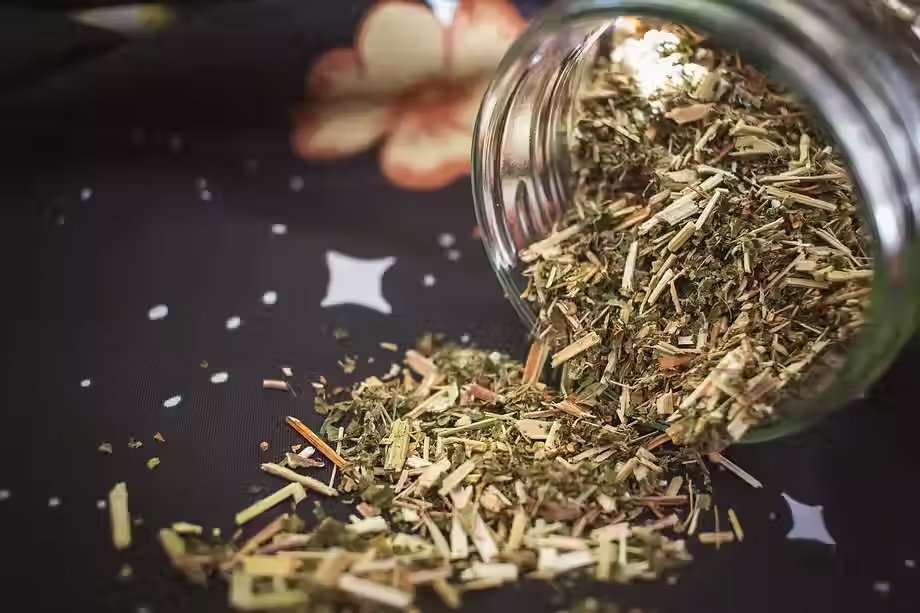
There are some plants I remember discovering because of their stories.
Others because of their appearance.
Meadowsweet entered my life because I had a headache.
At the time, I was still relatively new to herbalism and experimenting constantly with preparations. I had been working with willow bark, but willow was generally prepared as a decoction—simmered on the stove to extract constituents from tougher plant material.
And I preferred making infusions.
There was something about the process that felt more intimate to me.
Putting loose herbs into a pot. Pouring water over them. Waiting.
Letting the plant steep slowly while the water changed color and the scent filled the room.
So when I encountered Meadowsweet, Filipendula ulmaria, in my research into traditional herbs associated with headaches and tension, I was curious.
I ordered some.
And Meadowsweet joined the teapot.
The Headache Plant
I have always been prone to tension headaches, particularly when I'm deeply absorbed in something.
I clench my jaw when I write.
In fact, reading my original version of this Field Note reminded me that I wrote essentially this exact sentence in 2022:
Even now I'm trying to continually remind myself to loosen my jaw.
Four years later, I read that and immediately unclenched my jaw.
Apparently some things don't change.
When I first began experimenting with Meadowsweet, I often combined it with Linden in an infusion when I could feel that familiar tension building.
And I noticed something.
I slowed down.
Part of that was deliberate. Instead of reaching immediately for the fastest possible solution and continuing whatever I was doing, making an infusion required me to acknowledge that my body was asking for my attention.
Water had to boil.
Plants had to steep.
Tea had to be drunk.
Nothing about it was instantaneous.
At the time, I understood that primarily as herbal medicine.
Looking back, I think something else was happening too.

Let It Seep
I wrote something in the original version of this essay that I still believe, although perhaps differently than I did then:
It is important that we let things seep into the areas that need nurturing.
In 2022, I was thinking about the difference between an herbal infusion and the quick relief I associated with conventional pain medicine.
Now I'm less interested in setting those things against one another.
Sometimes a headache needs a cup of tea and a quiet room.
Sometimes it needs ibuprofen.
Sometimes it needs water, food, sleep, medical attention, or for the person hunched over a computer to please unclench her jaw.
But I still believe in the lesson hidden inside the teapot.
Some things cannot be rushed.
Herbs steep.
Bodies rest.
Children learn.
Stories develop.
Knowledge accumulates.
And sometimes the act of tending to something is valuable precisely because it asks us to stop long enough to notice it.
When I had a headache in those early years, I began telling my children:
Today I have a headache. I'm going to drink some tea and take things slowly.
That changed the rhythm of the house.
Maybe we read together.
Maybe we listened to an audiobook.
Maybe I asked them to try something themselves before asking me for help.
Without realizing it, a cup of Meadowsweet had become something larger than an herbal preparation.
It had become permission to move differently through the day.
Queen of the Meadow
Meadowsweet is a plant with an appropriately lovely collection of names.
Queen of the Meadow.
Meadow-wort.
Bridewort.
Its creamy white flowers grow in frothy clusters and carry a distinctive sweet fragrance. Long before I encountered the plant dried in an herbal jar, people valued Meadowsweet for that scent.
Historical accounts describe aromatic plants being scattered—or strewn—across floors in medieval and early modern halls. Crushed beneath people's feet, they released their fragrance into crowded interior spaces.
Meadowsweet became one of the plants associated with that tradition and was reportedly particularly favored in Elizabethan England.
Imagine it:
A hall crowded with bodies.
Rushes beneath your feet.
Herbs scattered among them.
And every footstep bruising the flowers enough to release their scent.
Before fragrance came from a bottle, sometimes it rose from the floor.

From Meadowsweet to Aspirin
Meadowsweet also occupies an interesting place in the history of medicine.
The plant contains salicylate compounds, a chemical family that also appears in willow and eventually became important to the development of modern pain-relieving medicines.
That history even became entangled with the name aspirin.
Meadowsweet was once classified botanically within the genus Spiraea, and when Bayer introduced acetylsalicylic acid under the name Aspirin at the end of the nineteenth century, the old Spiraea name contributed to the word.
The path from plant to medicine, however, is not as simple as saying that aspirin is merely Meadowsweet put into a tablet.
Plants contain complicated mixtures of constituents. Pharmaceuticals isolate, modify and standardize particular compounds.
Both belong to the history of medicine.
And Meadowsweet stands somewhere along that path, its old botanical name still hiding inside a word now found in medicine cabinets around the world.
A Plant with a Hero's Name
Then there is the name that originally caught my folklorist's attention:
lus Chúchulainn.
A Scottish Gaelic name associated in some sources with Meadowsweet connects the plant with Cú Chulainn, the great warrior of Irish mythology.
Cú Chulainn is famous not only for his extraordinary strength but for the terrifying battle frenzy known as the ríastrad—a transformation so violent that even his own people could be endangered by his return from battle.
Some later herbal traditions connect Meadowsweet with stories of cooling or calming the warrior's fury.
Whether the botanical name and story can be traced as cleanly through historical sources as modern herbal books sometimes suggest is something I now want to investigate further.
But perhaps that's exactly what a Field Note should do.
Not declare the story finished.
Mark the trail.
There is something here. Follow it.
What the Teapot Taught Me
When I first wrote about Meadowsweet, I thought the most important thing I could tell someone was what the herb did.
Its actions.
Its preparations.
Its dosage.
Its uses.
Now I think the thing I most want to preserve from that first encounter is much simpler.
I learned to wait.
Not because waiting is inherently better than acting quickly, or because an herbal preparation is inherently better than modern medicine.
Because waiting itself taught me something.
I couldn't make an infusion steep faster because I had too much to do.
The plant didn't care about my schedule.
So I boiled the water.
I loosened my jaw.
I let the herbs steep.
And for a little while, I did too.
Herbarium Notes
Scientific name: Filipendula ulmaria
Family: Rosaceae
Common names: Meadowsweet, Queen of the Meadow, meadow-wort, bridewor
tParts traditionally used: Flowers and aerial parts
Common preparations: Infusions, tinctures and traditional culinary preparations
Traditional herbal associations: Aromatic, astringent and anti-inflammatory traditions; historically associated with discomfort and digestive preparations
Safety note: Meadowsweet contains salicylate compounds and may not be appropriate for everyone, particularly people with salicylate sensitivity or certain medical conditions or medications. Consult an appropriate healthcare professional for individual guidance.
This Field Note discusses my personal experience and the historical and traditional use of plants. It is intended for educational and storytelling purposes and is not medical advice.
Sources & Further Reading
Angela Paine, Healing Plants of the Celtic Druids
Angela Paine, The Healing Power of Celtic Plants
Katja Swift and Ryn Midura, Herbal Medicine for Beginners
National Records of Scotland — Meadowsweet
Additional botanical and historical sources should be added during the 2026 revision to verify the early medicinal chemistry, Elizabethan strewing traditions, quotation, and the lus Chúchulainn tradition before publication.


