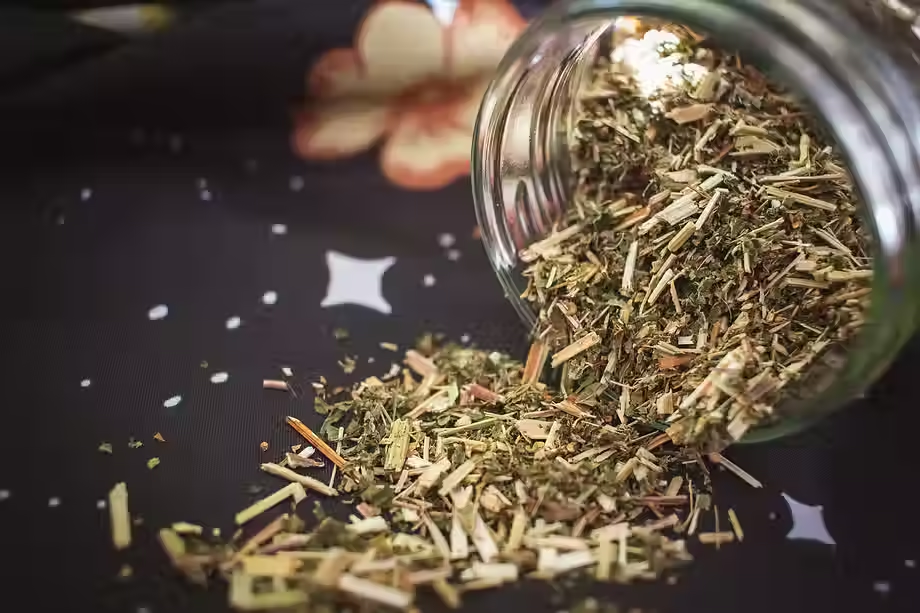
Isle of Linden Trees

Updated: Aug 25
Originally published January 17, 2022. Updated for Storybound Press.

Isle of Linden Trees
Not long ago, I found myself wandering down one of those research paths that begins with a single question and somehow opens into an entire forest.
At the time, I was studying Ogham, an early medieval Irish alphabet whose letters later became associated with trees and plants through medieval and modern traditions. I had been reading Celtic Tree Magic by Danu Forest and exploring the folklore, symbolism, and traditional uses of the trees connected with it.
Somewhere along the way, I stumbled across something entirely unrelated to the letter I was supposed to be studying.
Lindsey.
The name is connected to the historic Kingdom of Lindsey, an Anglo-Saxon kingdom in what is now eastern England. Its name has traditionally been interpreted as something like the island of Lind—and lind was an Old English word for the linden or lime tree.
Naturally, I immediately needed to know everything about linden trees.
Linden itself isn't one of the trees traditionally associated with the Ogham, so eventually I returned to what I was actually supposed to be researching. I had made myself a small set of wooden Ogham pieces that I could draw from a cup and study one at a time.
The first one I pulled was Hawthorn.

And that tree sent me somewhere else entirely.
I felt an immediate connection with Hawthorn—not only through its folklore, but through its long history of medicinal use. I wanted to begin working with the plant itself rather than simply reading about it, so I started searching for a Colorado apothecary.
I lived in Estes Park, which meant "local" presented a slight logistical problem. I wanted an independent apothecary close enough to feel connected to the place where I lived, but I also needed one that could ship herbs to me.
That's how I found Rebecca's Herbal Apothecary in Boulder.
Rebecca's had Hawthorn. And Oak.
But they also had Linden.
And Juniper, another plant I'd been drawn toward through my research into Scottish traditions and the practice of saining.
So I placed an order.
To my surprise, it arrived the next day.
This is truly where my herbal journey began.

Linden
Linden became one of the first herbs with which I developed a personal relationship rather than simply an academic one.
The genus Tilia includes the trees commonly called lindens, lime trees, and—particularly in North America—basswoods. Their flowers and leaves have a long history of use in traditional herbal practices, and linden is perhaps best known among modern Western herbalists as a gentle, relaxing nervine.
Katja Swift and Ryn Midura describe it in Herbal Medicine for Beginners as something like a "hug in a mug," and that description immediately made sense to me.
Not long after that first order arrived, I was moving through a particularly difficult period emotionally. One afternoon, feeling overwhelmed, I made myself a cup of linden tea and took it with me while I practiced yoga.
Something about that ritual stayed with me.
The warmth of the cup. The softness of the plant. The deliberate act of stopping long enough to prepare something for myself.
Linden became part of my daily practice for a time, sometimes on its own and sometimes alongside other herbs I was studying. More importantly, it became one of the first plants that taught me the difference between knowing about an herb and knowing an herb.
There are facts you can collect from books: its scientific name, its traditional actions, the parts harvested, its historical uses.
And then there is relationship.
Taste. Smell. Ritual. Season. Memory.
The particular plant you reach for without having to look at the label anymore.
Linden was one of the first plants that became that for me.

Linden in Story and History
Perhaps it shouldn't be surprising that a tree I first encountered through the history of my own name has accumulated so many human stories around it.
Across parts of Europe, linden trees became gathering places. Some ancient specimens still stand in village squares and communal spaces, carrying generations of local history beneath their branches.
The tree also appears throughout European folklore and cultural tradition, frequently associated with protection, love, community, and sacred or civic space. Its soft, workable wood has been used for carving and other crafts, while the fibrous inner bark of Tilia species has a long history of being processed into cordage and textiles.
That combination fascinates me.
Linden can be medicine, material, meeting place, symbol and story—all while simply being a tree.
Perhaps that's part of why I was drawn to studying plants in the first place. The deeper you look at one species, the harder it becomes to separate botany from human history.
A plant is rarely only a plant.
A Beginning
When I originally wrote this piece in January 2022, I was standing at the very beginning of my herbal practice.
I couldn't have known then where that curiosity would lead me: into herbalism, botany, wildcrafting, foraging and mycology; into creating my own small apothecary; and eventually into the broader study of plants, folklore, ecology and storytelling that continues to shape my work today.
Looking back, I love that one of the first threads began with something as simple as discovering an old meaning hidden inside a name.
An island of linden trees.
I followed it.
And somewhere along the way, I found a forest.
Herbarium Notes
Scientific name: Tilia spp.
Family: Malvaceae
Common names: Linden, lime tree, basswood
Parts traditionally used: Flowers and leaves
Common preparations: Infusions and topical preparations
Traditional herbal character: Linden is commonly described in Western herbalism as a relaxing nervine with cooling and moistening qualities.
This essay reflects my personal experience and study of traditional herbal practice and is intended for educational and storytelling purposes, not as medical advice.
Sources & Further Reading
Danu Forest, Celtic Tree Magic: Ogham Lore and Druid Mysteries
Katja Swift and Ryn Midura, Herbal Medicine for Beginners
Additional historical and botanical sources should be added during the 2026 revision to support the discussion of linden's cultural history and traditional uses.