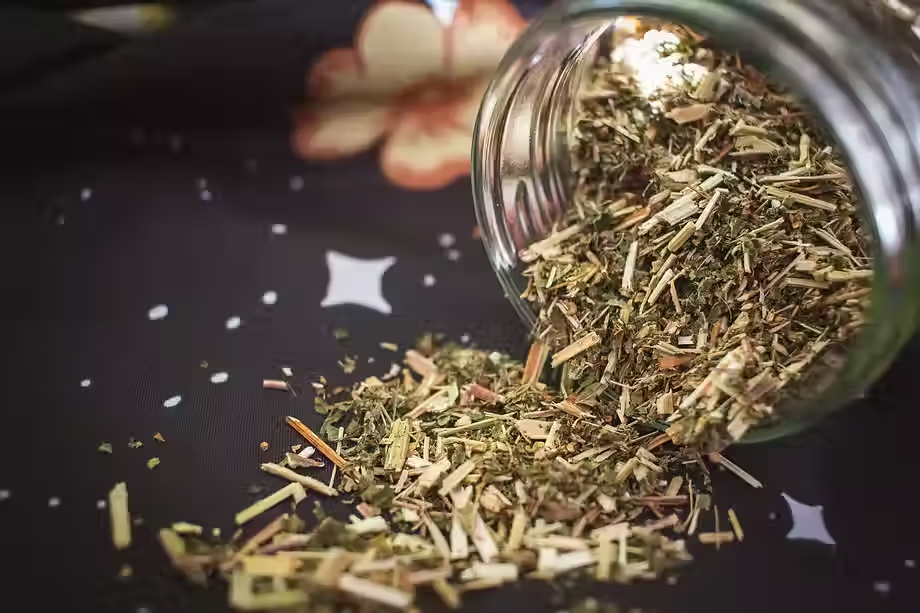
Nine Plants for Love, Longing & Devotion

Originally published as a Valentine's Day herbal guide in 2022. Updated for Storybound Press.
“Love I desire, come to me, as is my will, so mote it be.”

Humans have apparently always been terribly impatient about love.
We have asked flowers who we will marry.
Carried plants to attract lovers.
Scattered petals beneath the moon.
Burned herbs, tied charms around our necks, tucked flowers into wedding bouquets and watched plants for signs that someone, somewhere, might love us back.
And honestly?
I find that delightful.
When I originally wrote this piece for Valentine's Day in 2022, I approached these plants primarily as an herbalist. I wanted to gather herbs associated with love and abundance and offer ways of incorporating them into the holiday.
Coming back to it years later, I find myself considerably more interested in the stories.
Because Valentine's Day may be our modern excuse to cover everything in pink hearts, but the desire beneath it is ancient.
Tell me something about love.
People have been asking the natural world to answer that question for a very long time.
Here are nine plants we've asked.
Red Clover — A Little Luck in Love
Most people know the familiar promise of the four-leaf clover.
Luck.
But clover folklore becomes considerably stranger once you start counting leaves.
Different numbers have accumulated different meanings in folk traditions, including love, prosperity and supernatural encounters. Some traditions even suggest carrying particular clovers to attract love.
My own relationship with Red Clover began much more simply.
I remember finding it while hiking with my children and showing them how to carefully pull one of the tiny individual flowers from the blossom and taste the drop of sweetness hidden inside.
It was one of those tiny pieces of plant knowledge that feels almost like a secret when you're a child.
A whole flowerhead filled with little straws of nectar.
And perhaps that's appropriate for a plant we've spent so much time associating with luck.
Sometimes fortune is simply knowing where sweetness is hiding.
Lemon Balm — Follow the Bees
Lemon Balm carries its attraction openly.
You can smell it.
Its genus name, Melissa, comes from the Greek word for bee, and the relationship between aromatic plants, bees and human ideas about fertility and abundance stretches deep into Mediterranean history.
Later folklore and magical traditions gave Lemon Balm associations with love, happiness and attraction.
I love the simplicity of the image beneath all of it:
If you want sweetness to come near,
plant something the bees will find.
Wild Rose — Call Your Lover from the Dark
Rose hardly needs an introduction as a flower of love.
It has belonged to goddesses, poets, lovers and graves for centuries. Roses appear throughout Greek and Roman mythology and became enduring symbols of Aphrodite and Venus.
But some of my favorite rose traditions are considerably less polished than the bouquet waiting at a florist.
One English folk custom recorded in later collections describes a person going into a churchyard at midnight, scattering rose leaves and reciting a charm intended to summon a vision of their future lover.
A churchyard.
At midnight.
With roses.
Modern Valentine's Day could stand to be a little weirder.
Rosemary — Remember Me
Rosemary's relationship with love is intertwined with something perhaps even more enduring:
remembrance.
The plant appears historically in weddings, funerals and ceremonies where memory mattered. Brides carried it. Mourners placed it with the dead.
Love and grief have always lived remarkably close together.
To give someone a plant of remembrance is to make a quiet request:
Remember this day.
Remember this person.
Remember me.
St. John's Wort — Will I Be a Bride?
Old love divination is wonderfully specific.
One tradition associated with St. John's Wort describes a young woman gathering the plant and watching what happens to it afterward. Its condition could supposedly reveal whether marriage waited for her in the coming year.
Plants became oracles because humans desperately wanted certainty about uncertain things.
We still do.
We've simply changed where we ask the questions.
Thyme — Courage for the Heart
Not every love charm needs to attract someone else.
Thyme has accumulated associations with courage, purification and strength across European traditions.
And perhaps courage belongs in any collection of love folklore.
It takes courage to tell someone.
To leave someone.
To choose someone.
To choose yourself.
To say what is true and allow another person to answer however they will.
A love charm for courage might be considerably more useful than one promising control over another person's heart.
Yarrow — The Marriage Herb
Yarrow has one of my favorite relationships with love because its traditions frequently concern not simply attraction, but the bond itself.
The plant appears in European love divination and wedding folklore and has acquired associations with fidelity, protection and enduring partnership.
There is something different about that.
Many love charms ask:
Who will come?
Yarrow asks what happens after they arrive.
How do two people protect what they've chosen?
How do they remain themselves while becoming something together?
Perhaps love needs boundary plants as much as it needs roses.
Apple — The Forbidden Thing
Apples have spent thousands of years getting blamed for things.
Love.
Desire.
Knowledge.
Temptation.
Immortality.
Discord.
Depending upon which mythology you're reading, an apple can start a war, grant access to another world, belong to a goddess or represent the thing someone has forbidden you to reach for.
That makes the apple an interesting symbol for love.
Because underneath all of those stories is desire.
I want.
And perhaps the more interesting question isn't whether desire is dangerous.
It is:
Who taught us which things we were allowed to want?
Strawberry — Finding the Way Back
Strawberries carry love symbolism of their own, helped considerably by their red color and heart-like shape.
But the story that first made me look differently at them was a Cherokee story I encountered during my early herbal studies.
It tells of the first man and woman after a quarrel separates them. As the woman travels away, strawberries eventually cause her to stop. Their sweetness interrupts her anger long enough for memory and affection to return, opening the possibility of reconciliation.
There is much more to this traditional story than I can responsibly reproduce from a secondhand retelling here, and it belongs to a living Cherokee storytelling tradition deserving of its own context.
But one idea from my first encounter with it has stayed with me:
Love cannot always be chased into returning.
Sometimes someone needs enough space to discover what their own heart wants.
That feels considerably more meaningful to me than a charm designed to force a lover back.
What We Ask of Plants
Looking back at this collection, I'm struck by how little has changed.
We may no longer leave Hawthorn branches on posts to discover which direction our future husband will come from.
We may not scatter rose petals around ourselves in a churchyard at midnight.
But we still ask:
Will someone love me?
Will this last?
Should I stay?
Should I go?
Can I forgive them?
Can they forgive me?
How do I know when I've found the person I'm supposed to find?
Perhaps the plants were never expected to answer those questions.
Perhaps ritual simply gave people somewhere to put them.
A clover to carry.
A flower to scatter.
A sprig to tuck into a wedding bouquet.
A berry sweet enough to make someone stop walking for just a moment.
And maybe that's why I still love these traditions.
Not because I believe a plant can command another person's heart.
But because humans have always needed ways to hold the enormous uncertainty of loving one another.
So we handed some of it to the plants.
And, for centuries, they carried it.
This Field Note explores historical, folkloric and cultural relationships between people and plants. Folk practices are presented as traditions rather than instructions or guarantees. Botanical materials can have medicinal effects, contraindications and drug interactions; identification and appropriate safety guidance matter when plants are consumed.
Sources & Further Reading
Angela Paine, Healing Plants of the Celtic Druids
Maia Toll, The Illustrated Herbiary
Ellen Evert Hopman, The Sacred Herbs of Spring
Additional folkloric, historical and culturally specific sources should be added during the 2026 revision, particularly for individual British folk customs and the Cherokee strawberry story.