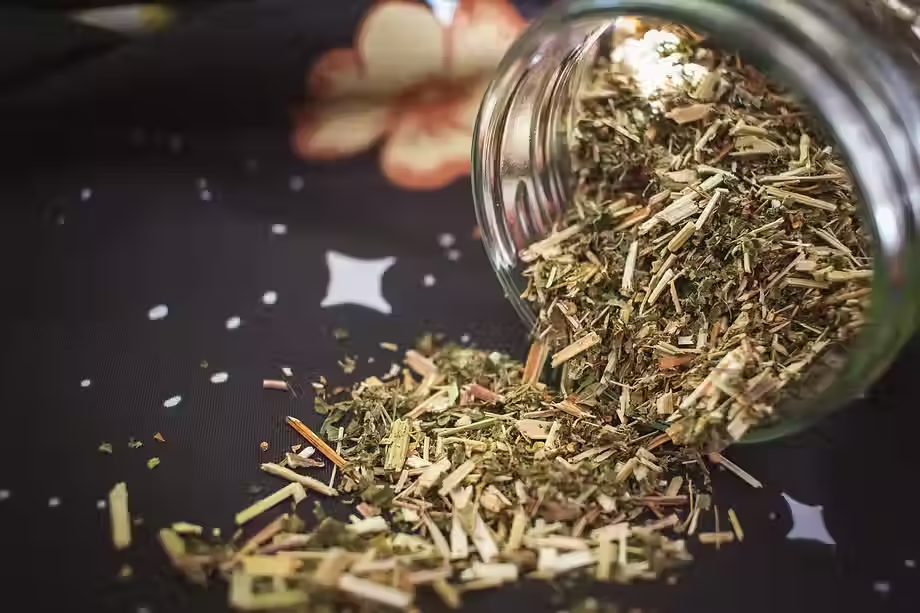
Tulsi: A Sacred Basil

Originally published in 2022. Updated for Storybound Press.

Tulsi was one of the first herbs I loved simply because I enjoyed having it around.
When I began experimenting with my own herbal tea preparations, I added it to all sorts of blends. It was intensely aromatic, slightly sweet, and somehow seemed to transform whatever I put it with.
And, admittedly, I thought it was beautiful.
Tulsi—Ocimum tenuiflorum, commonly called holy basil—is a member of the mint family. Despite the familiar name "basil," this isn't quite the same plant as the culinary basil most of us recognize from the kitchen.
I originally encountered it through herbalism, where tulsi is commonly described as an adaptogen and nervine. But what made the plant memorable to me wasn't a list of herbal actions.
It was the way I experienced it.
The Plant I Reached for While Making Things
During those early years of my herbal practice, I was also constantly making things.
Businesses. Art. Projects. Plans.
I have always had a tendency to throw myself completely into a new idea. Something catches fire in my imagination and suddenly I am building the whole thing at once, usually faster than I can create a roadmap for it.
Some ideas survived that initial blaze.
Others burned brightly and disappeared.
At the time I originally wrote this Field Note, my mother and I were beginning another herbal business together, and I was noticing how easily the excitement of creating something could become overstimulation.
Tulsi had found its way into the little collection of plants I associated with those moments.
Linden.
Wood Betony.
Tulsi.
I'd make an infusion and sit with whatever enormous thing my brain had decided needed to exist immediately.
What I noticed most about tulsi was what I described at the time as its ability to transform prickly emotions.
I still like that description.
Not erase them.
Not cure them.
Transform them.
There was something about the ritual—the fragrance rising from the cup, the warmth, the act of preparing it—that helped create enough space for me to move through whatever I was feeling rather than simply remaining caught inside it.
Years later, I am less interested in making a medical claim about what happened in those moments than I am in remembering the relationship I developed with the plant.
Tulsi became associated with making space.
And I find it fascinating that I encountered that idea through herbalism before learning just how much deeper tulsi's relationship with human spiritual practice goes.

The Sacred Plant
Tulsi isn't simply an herb with an interesting history.
It is a sacred plant within living Hindu traditions.
Often associated with the goddess Tulsi and with Vishnu and his avatars, the plant has been cultivated in and around Hindu homes and temples for centuries. Caring for tulsi can itself be an act of devotion, and the plant occupies a place where the ordinary tending of a living thing becomes religious practice.
Watering a plant.
Lighting a lamp.
Walking around it.
Gathering its leaves.
Acts that might appear mundane from the outside can carry sacred meaning within the traditions surrounding tulsi.
The plant is also associated with purification, protection, prayer and meditation. Tulsi leaves and water infused with them may be incorporated into rites surrounding death, connected with hopes for moksha—liberation from the cycle of death and rebirth.
That changes the way I think about the plant.
When I first encountered tulsi, I understood it primarily through the vocabulary of Western herbalism: adaptogen, nervine, aromatic.
Useful words.
But incomplete ones.
Because plants do not belong solely to the systems through which we first encounter them.
What a Plant Carries
This is one of the lessons I appreciate most when revisiting my earliest herbal writing.
I used to begin with:
What does this plant do?
Now I am much more likely to ask:
What does this plant carry?
Botany.
Medicine.
Memory.
Religion.
Migration.
Ritual.
Generations of human relationships that existed long before a bundle of dried leaves ever arrived on my shelf.
Tulsi is especially good at revealing the limitations of looking at plants only through a list of medicinal actions. Its story cannot be separated from the people for whom it remains sacred.
And perhaps that's another form of attention herbalism eventually taught me.
Learning about a plant also means learning when its story isn't mine.
I can tell you about the tulsi I brewed while trying to make sense of too many ideas at once.
I can tell you about its extraordinary scent.
I can tell you that I still remember describing difficult emotions as becoming less prickly around it.
But surrounding my small personal experience is a much older, much larger tradition.
That deserves to remain visible too.
Herbarium Notes
Scientific name: Ocimum tenuiflorum
Synonym: Ocimum sanctum
Family: Lamiaceae
Common names: Tulsi, holy basil
Parts traditionally used: Leaves and flowering aerial parts
Common preparations: Infusions and other traditional preparations
Traditional herbal associations: Aromatic, adaptogenic and nervine traditions
Cultural note: Tulsi is sacred within Hindu traditions and remains part of living religious and cultural practices. Its ceremonial uses should be understood within those traditions rather than treated solely as historical herbal folklore.
This Field Note discusses my personal experience and the historical and traditional use of plants. It is intended for educational and storytelling purposes and is not medical advice.
Sources & Further Reading
Herbal Medicine for Beginners — Katja Swift and Ryn Midura
Encyclopaedia Britannica — “Holy Basil”
Additional botanical and Hindu religious/cultural sources should be added during the 2026 revision before publication.