

“Sell Your Coat and Buy Betony”

Updated: Aug 25
Originally published January 21, 2022. Updated for Storybound Press.

There is an old saying about Wood Betony:
“Sell your coat and buy betony.”
Whether anyone actually surrendered a perfectly good coat for a bundle of herbs, I cannot say. But the sentiment tells you something about the reputation this little plant once carried.
For centuries, Wood Betony was regarded as an extraordinarily valuable herb. It appeared in medicinal traditions, monastery gardens, charms and remedies. People used it for ailments of the head and body—and, according to old herbals and folklore, for considerably stranger afflictions involving nightmares, spirits and sorcery.
By the time I encountered it, however, I had never even heard its name.
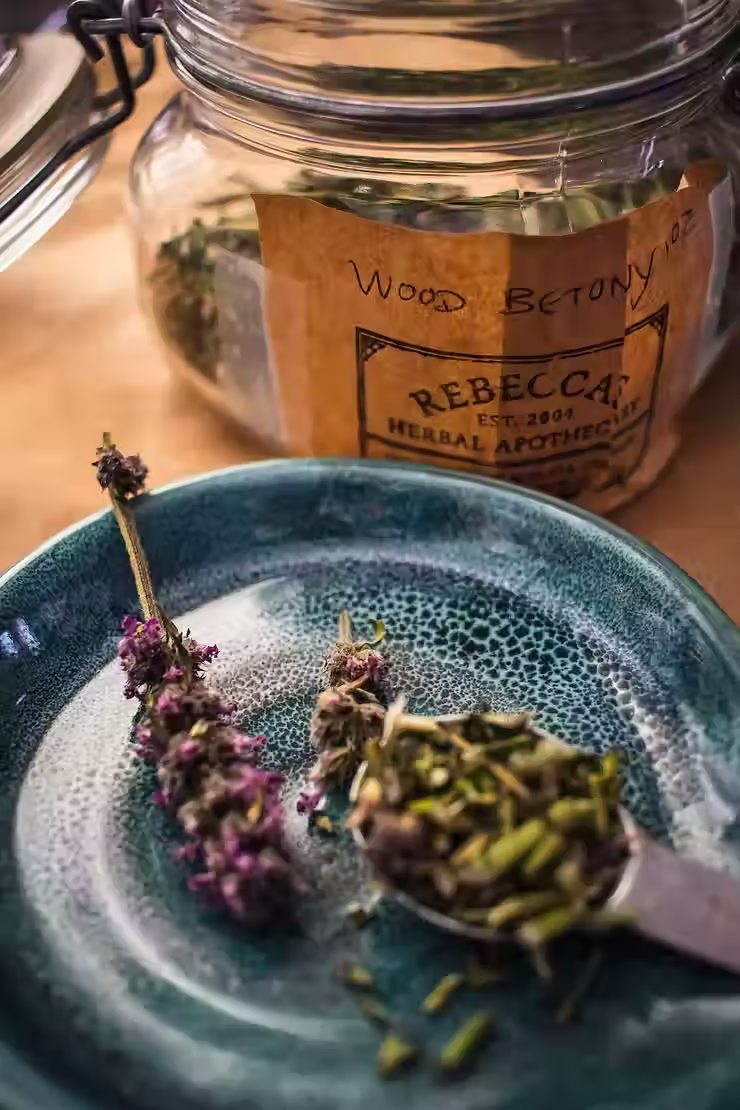
I found Wood Betony during the earliest months of my herbal practice, while making my way through Katja Swift and Ryn Midura's Herbal Medicine for Beginners. I kept noticing the same unfamiliar plant appearing in discussions of tension, the nervous system and the relationship between mind and body.
Eventually curiosity won.
I ordered some.
And when the dried herb arrived from the apothecary, I remember being struck by how beautiful it was.
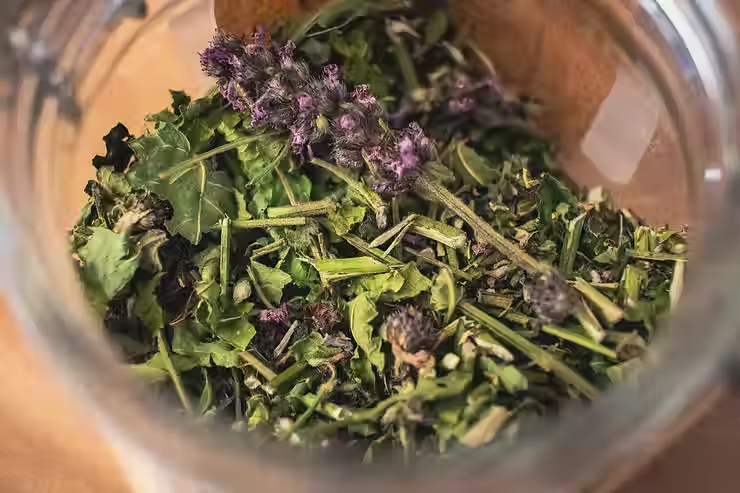
There were whole stems among the loose herb, still holding their little spikes of flowers. The color was remarkably vibrant. Until then, much of what I knew about Wood Betony existed as words on a page.
Suddenly I was holding the plant itself.
And the more I learned about it, the stranger—and older—its story became.
A Plant for the Head
Wood Betony, commonly known today as Stachys officinalis or Betonica officinalis, belongs to the mint family, Lamiaceae.
Traditional Western herbalists developed a particularly strong association between betony and the head. It appears repeatedly in historical discussions of headaches and tension, while modern herbal traditions often describe it as a relaxing nervine.
That was what originally interested me.
At the time, I was fascinated by the idea of plants that herbalists described as grounding—plants used within a tradition not simply because of a particular symptom, but because of the way an herbalist understood the whole person.
I began drinking Wood Betony in infusions, often alongside Linden and Calendula.
What stayed with me wasn't the idea that one plant could somehow solve the complicated workings of a human mind.
It was the ritual of returning to my body.
Preparing the herbs. Holding the warm cup. Smelling them. Sitting still long enough to notice where I actually was.
My early herbal practice was beginning to teach me that tending to yourself could sometimes be an act of attention.
Wood Betony became associated with that act for me.
But centuries before I ever held a cup of it, people had imagined that this plant could protect the mind from considerably stranger things.
Betony Against the Things in the Dark
This is where Wood Betony becomes irresistible to the folklorist.
Historical herbals and later accounts attribute an extraordinary range of powers to the plant.
Betony was carried or worn for protection. It was associated with guarding sleepers from disturbing dreams and frightening visions. Some traditions placed it between the vulnerable human world and supernatural harm—sorcery, spirits, devils and whatever else might be waiting beyond the safety of the firelight.
One account attributed to Anglo-Saxon herbal tradition recommends betony against terrifying nocturnal visitors and troubling dreams.
Other traditions describe it being planted near sacred spaces or carried as a protective herb.
And then there are the remedies.
One attributed to the medieval Welsh medical tradition of the Physicians of Myddfai calls for betony to be combined with wine, honey and exactly nine peppercorns, taken over nine days, for an ailment of the head.
Nine peppercorns.
Nine days.
That is precisely the sort of detail that stops me in my tracks.
Because suddenly we are no longer looking only at a list of ingredients.
We are looking at the place where medicine, ritual, number symbolism and belief begin to overlap.
The Physic Garden
Betony also found a home in the physic gardens of medieval Europe.
These were gardens cultivated specifically for useful plants, particularly those used in medicine. Monasteries became important places for cultivating, recording and preserving knowledge about them.
I love imagining Wood Betony there.
A small plant growing behind monastery walls while generations of people attempted to understand what it could do.
Some observations became medicine.
Some became folklore.
Some probably became both.
And centuries later, separating one cleanly from the other isn't always possible.
That ambiguity is part of what makes old plant traditions so fascinating to me.
The Plants Become Stories
When I first wrote about Wood Betony in January 2022, I approached it primarily as a beginning herbalist.
I wanted to know what it was for.
I wanted actions, preparations, energetics. I wanted to understand where it belonged on an herbalist's shelf.
Four years later, I find myself much more interested in another question:
Why did generations of people believe this plant mattered so much?
Why did a plant associated with the head become a plant associated with nightmares?
How did medicine become protection?
How did protection become magic?
Why nine peppercorns?
Those questions are harder to fit neatly into an herbarium.
But they are exactly the questions that eventually carried me from herbalism deeper into folklore, natural history and storytelling.
I began with plants because I wanted to understand how people used them.
I stayed because I wanted to understand the stories people told about them.
And Wood Betony has accumulated a remarkable number of stories for such a small plant.
Perhaps enough, after all, to justify selling the coat.
Herbarium Notes
Scientific name: Betonica officinalis (also classified as Stachys officinalis
)Family: Lamiaceae
Common names: Wood Betony, common hedgenettle, bishop's wort
Parts traditionally used: Primarily the aerial parts
Common preparations: Infusions and tinctures
Traditional herbal associations: Nervous-system support, relaxation and ailments of the head
Identification note: Wood Betony should not be confused with plants in the genus Pedicularis, some of which are also called betony.
This essay discusses my personal experience and the historical and traditional use of plants. It is intended for educational and storytelling purposes and is not medical advice.
Sources & Further Reading
Katja Swift and Ryn Midura, Herbal Medicine for Beginners
Angela Paine, Healing Plants of the Celtic Druids
Additional primary and scholarly sources should be added during the 2026 revision to verify historical remedies, folklore and etymological claims before publication.

